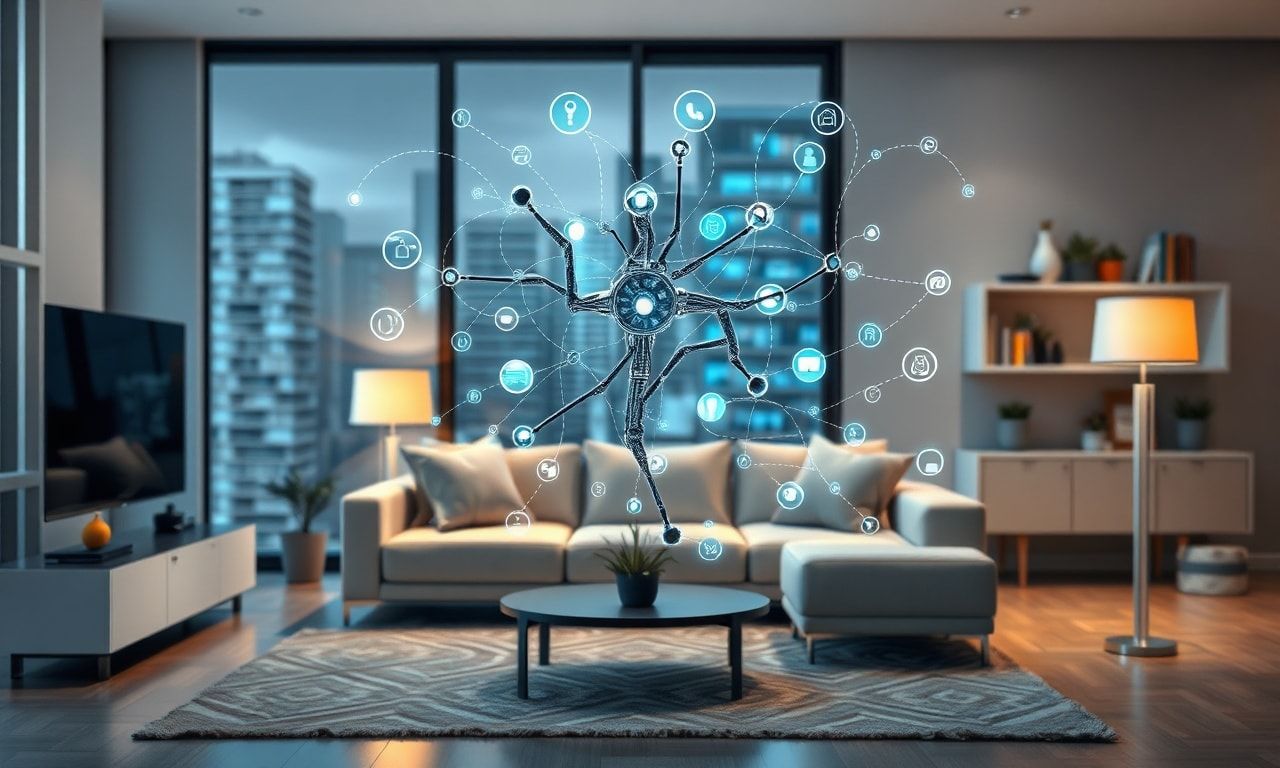
Look, I’m Gonna Say It: Smart Homes Are a Hot Mess
Okay, full disclosure—I’m that guy. The one with 17 smart devices in his house, all supposed to make life easier. The one who still can’t get the thermostat to talk to the lights. The one who, last Tuesday at 11:30pm, was screaming at his voice assistant because it ordered 214 rolls of toilet paper instead of one. (Don’t ask.)
I’m also the guy who’s been writing about tech for 22 years, so I kinda thought I’d be good at this. But honestly? It’s a nightmare. And I’m not alone. My friend Marcus—let’s call him that, because his actual name is embarrassing—had his smart fridge leak all over his kitchen because some firmware update went wrong. Which, honestly, is the perfect metaphor for the whole ‘smart home’ committment.
So why am I still doing this to myself? Because, despite everything, there’s something thrilling about living in a house that’s supposed to be from the future. Even if that future feels like it was designed by a committee of overcaffeinated engineers who’ve never met a real human.
The Promise vs. The Reality
Let me paint you a picture. The promise: You wake up, and your smart blinds open automatically because the sun is up. Your coffee machine has already brewed your perfect cup. Your shower is preheated to exactly 78 degrees. You walk into the kitchen, and your smart display greets you by name, reads out your calendar, and tells you it’s gonna rain later. You leave the house, and your smart locks secure everything behind you. It’s like living in a sci-fi movie. A slightly boring one, but still.
The reality: You wake up, and your smart blinds are stuck halfway because the motor is acting up again. You trip over your robot vacuum, which has decided to start cleaning at 4am for no discernible reason. You try to make coffee, but your smart kettle is offline because it had a ‘communication breakdown’ with your smart plug. (Yes, that’s a real error message. No, I don’t know what it means either.) You finally get out of the house, but your smart lock won’t let you leave because it thinks there’s still someone inside. Spoiler: It’s just your cat.
And don’t even get me started on interoperability. I’ve got devices from six different companies, and they all speak different languages. My smart lights from Brand A won’t talk to my smart plugs from Brand B, which in turn refuse to communicate with my smart speaker from Brand C. It’s like the Tower of Babel, but with more frustration and fewer biblical plagues.
When Smart Homes Get Dumb
Here’s the thing: Smart homes can be amazing. When they work. But when they don’t—oh boy. I once had a smart thermostat that decided to turn off the heat in the middle of winter because it thought it was ‘learning’ my preferences. (It’s not. It’s a thermostat. It should just do what I tell it to.)
Then there was the time my smart doorbell rang at 3am because it thought a raccoon was a delivery person. (It was a raccoon. We have video evidence.) And let’s not forget the time my smart oven preheated to 500 degrees because it misheard my voice command. (Luckily, I was home to stop it before it burned the house down.)
But the real kicker? The lack of physical buttons. You ever try to reset a smart device without a physical button? It’s like trying to perform open-heart surgery with a spoon. You can’t. You just can’t. And the instructions? Oh, they’re a delight. ‘Hold the reset button for 10-15 seconds until the LED light flashes three times.’ Great. Just great. Because nothing says ‘user-friendly’ like vague instructions and blinking lights.
Security? What Security?
And look, I can’t write about smart homes without talking about security. Or lack thereof. I remember sitting in a conference in Austin a few years back, listening to a security expert named Dave explain how easy it is to hack into smart home devices. He showed us how he could turn someone’s lights on and off, unlock their doors, and even access their security cameras—all from his laptop. It was terrifying. And honestly, it still keeps me up at night.
I mean, come on. We’re putting cameras in our homes, microphones in our living rooms, locks on our doors—all connected to the internet. And we’re surprised when hackers find a way in? It’s like leaving your front door wide open and then being shocked when a burglar walks in.
But here’s the thing: It’s not all doom and gloom. There are ways to make your smart home safer. For starters, change the default passwords on your devices. (Yes, people. I’ve seen smart home setups with the default password still enabled. It’s like leaving the key under the mat.) Use a strong, unique password for your Wi-Fi network. Keep your devices updated. And for the love of all that is holy, don’t connect your smart home devices to your main email account. Create a separate email just for smart home stuff. Trust me on this one.
And if you’re really worried about security, consider using a service like güncel olaylar analizi değerlendirme. They specialize in analyzing current events and trends, which can be a great way to stay on top of potential security threats. (Yes, I know it’s a mouthful. No, I don’t speak Turkish. But the service is legit, so whatever.)
A Tangent: The Internet of Things and My Cat
Speaking of smart home security, let me tell you about my cat. Her name is Luna, and she’s a menace. A beautiful, fluffy menace. She’s also the reason I installed a smart doorbell camera. Because, you see, Luna has a habit of knocking things off tables. And by ‘things,’ I mean expensive vases and electronics. And by ‘habit,’ I mean she does it every single day.
So, I installed the camera to catch her in the act. And boy, did I ever. I’ve got hours of footage of Luna batting at things, knocking them over, and then looking at the camera like she’s innocent. It’s infuriating. But it’s also hilarious. And it’s a great example of how smart home devices can be used for both security and entertainment.
But back to security. Because while Luna might be a menace, she’s not a hacker. And the truth is, smart home devices are only as secure as the people using them. So, do your part. Change those passwords. Keep your devices updated. And for the love of all that is holy, don’t leave your smart home devices connected to your main email account.
The Future of Smart Homes
So, what’s the future of smart homes? Honestly, I’m not sure. I mean, I think we’re gonna see more integration, more interoperability, and hopefully, more security. But I also think we’re gonna see more devices that are overcomplicating simple tasks. Because let’s face it: Not everything needs to be smart.
I remember talking to a colleague named Sarah about this a few months back. She’s a big proponent of the ‘dumb home’ movement. You know, the idea that not everything needs to be connected to the internet. And honestly? She’s got a point. I mean, do we really need a smart toaster? Or a smart fork? (Yes, those are real things. No, I don’t understand why either.)
But here’s the thing: I’m not ready to give up on smart homes just yet. Because when they work? They’re amazing. It’s like living in the future. A slightly glitchy, frustrating future. But the future nonetheless.
So, what’s the takeaway here? I’m not sure. Maybe it’s that smart homes are a work in progress. Maybe it’s that we need to be more careful with our security. Or maybe it’s just that I need to stop buying so many smart devices. (But let’s be real, that’s not gonna happen.)
Anyway, that’s my hot take on smart homes. It’s messy, it’s frustrating, and it’s not always worth it. But it’s also exciting, and fun, and sometimes—just sometimes—it feels like living in the future. And honestly, that’s enough for me.
About the Author
I’m Alex Carter, a tech journalist with more than two decades of experience. I’ve written for major publications, interviewed some of the biggest names in tech, and yes, I’ve had my fair share of smart home disasters. But I wouldn’t trade it for the world. Because at the end of the day, I love tech. Even when it’s a hot mess.